Leadership that responds to the person and the task.
An approach that helps a new employee may not suit an experienced colleague. Learn to read a person’s needs for a specific task and choose suitable direction, support and follow-up.
Workplace & education casesPractical decisions & discussionTraining shaped around needs
For managers, team leaders, educational leaders, business owners and educators.
What will you practise?
Consider competence, confidence and motivation for a specific task.
Distinguish a need for instructions from a need for support.
Review directing, coaching, supporting and delegating approaches.
Set clear expectations and adjust follow-up as performance develops.
An example in practice
An experienced employee hesitates over an unfamiliar task: do they need more instruction, a conversation that supports confidence, or both? Understand what they know and what is getting in the way before responding.
How is the training delivered?
Analyse realistic situations and choose a suitable response.
Discuss communication, delegation and follow-up options.
Identify an application in the participant’s context.
From school to workplace
In schools: choose suitable direction and support for an educator or learner on a specific task.
In organisations: clarify expectations, delegate and follow performance development.
In teams: avoid excessive instruction or leaving someone without needed support.
Scope, duration, format, fees and language are agreed around the training need.
The Classroom Black Box connects understanding students with choosing a suitable leadership response. Both Arabic and English editions are included in one purchase.
Questions that open up thinking and develop ideas.
Turn a lesson or training topic into questions and activities that help participants generate, examine and develop ideas. Connect critical, organisational and creative thinking in one learning experience.
When ideas repeat, SCAMPER offers focused ways to change them: what could we substitute, combine, remove or rearrange? Apply these questions to an activity, product or service.
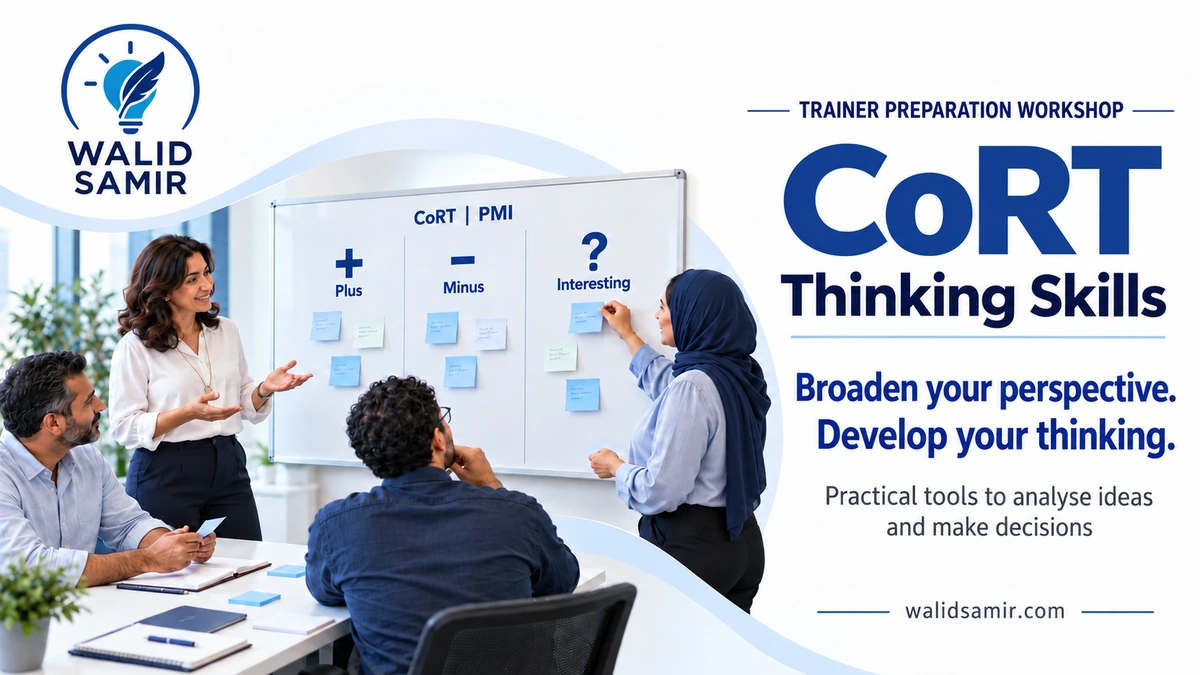
Practical tools for moving beyond a first impression to examine factors, consequences, alternatives and viewpoints. The recorded trainer preparation workshop covers all six CoRT sections and 60 thinking tools.